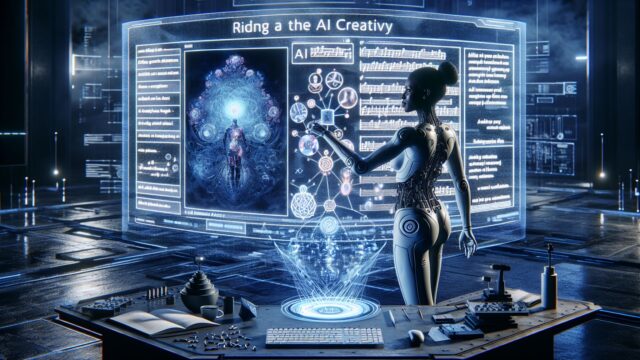
Hey tech enthusiasts and creative pioneers! Today, I want to take you on a journey down the eccentric, colorful, and sometimes mind-bending path of Artificial Intelligence (AI) in the creative arts. Now, before you roll your eyes thinking of Terminator-esque robots painting like Picasso, bear with me. AI may not yet have a soul, but it’s certainly got style, and it’s shaking up the art world in ways we couldn’t have imagined a few years ago.
From Algorithms to Artistic Masterpieces
Let’s start with the basics: AI-powered art might sound like a futuristic concept, but the reality is it’s already here, and it’s changing how we understand and create art. At the heart of AI creativity lies the algorithm, that buzzword we all love to hate. It may seem impersonal, but these clever lines of code are the brushstroke artists of the digital age. Thanks to advances in machine learning, neural networks can now learn how different art styles work, copy famous artists, or even create entirely new art forms.
Think about OpenAI’s DALL-E or Google’s DeepDream. These deep learning models have painted everything from surreal landscapes to hybrid animals. Yes, I’m talking about that dog-slug you can’t unsee. And let’s not forget the famous AI-generated portrait sold by Christie’s for a cool $432,500 in 2018. Artists are increasingly using algorithms as a collaborative partner, blurring the lines between man and machine.
A New Palette: Tools for the 21st Century Artist
Now, don’t get me wrong. I’m not declaring the death of human creativity. Quite the opposite! AI is becoming a tool for artists that opens up an entire universe of possibilities. It’s like having a magical paintbrush that adapts to your imagination while challenging you to rethink what art can be.
With accessible platforms like RunwayML and DeepArt, even those of us who can’t draw a stick figure can explore our creative side. Artists, designers, and filmmakers are using these tools to enhance their work, experiment with new concepts, and push the envelope of creative expression. You can generate music, films, or digital artwork with just a few clicks. The era of the digital Renaissance is upon us.
Democratizing Creativity: The Good, the Bad, and the Ugly
AI’s impact isn’t limited to just giving artists new tools. It’s making art creation accessible to the masses. School kids to grandmas can now tap into AI tools to create their masterpieces without needing years of formal training. This inclusivity is fantastic for creativity but also brings its own set of challenges.
Picture a virtual gallery overflowing with millions of AI-generated artworks. How do we pick out the exceptional pieces from the sea of mediocrity? Is this new accessibility making us appreciate traditional art forms less? It’s a dizzying world to navigate. AI gives everyone a voice in art, but with all that noise, the role of the human artist as a curator of taste becomes even more important.
AI-Driven Storytelling: The Next Chapter of Imagination
Now that we’ve covered visual arts, let’s explore storytelling, where AI is spinning narratives that could rival the creativity of your favorite authors. Take, for example, OpenAI’s GPT-3, which can compose poetry, scripts, and even entire novels. While it may lack the beautiful prose of classic authors, AI has real potential as a powerful tool for brainstorming and developing new storylines.
Fancy a bit of interactive storytelling? AI isn’t just writing stories. It’s creating gaming narratives, personalizing stories based on user preferences, and creating dynamic plots that evolve as players make decisions. It’s like your own customizable Choose Your Own Adventure book, though admittedly without those campy, beautiful illustrations.
That said, we’ve got a long way to go before AI can entirely step into Shakespeare’s shoes. While it can copy style and structure, true inspiration and emotional depth are still out of reach for our silicon scribes.
The Road Ahead: Envisioning Future Artistry
So, where do we go from here? The combination of AI and human creativity could completely redefine the creative process. Artists may become curators of AI creativity, embracing their muse’s synthesized inspiration or challenging it through collaboration. Perhaps we’ll see creative teams where humans and AI work together, creating works more profound than either could achieve alone.
On the speculative side, imagine a future where AI-driven art installations reflect the mood of a city or where a personal AI artist creates a unique daily artwork based on your mood and tastes. The possibilities are pretty exciting.
Sure, skeptics might worry about the potential for AI to make art less personal. But let’s face it, technology has always been a catalyst for change in art, from the printing press to Photoshop. AI could be the co-creator that helps us forge new emotional connections, drive innovation, and broaden our creative horizons.
Conclusion: Embracing the AI Art Movement
As we welcome this new era of AI in the creative arts, I encourage you to think of it not as a replacement but as an exciting extension of human creativity. Sure, AI has its quirks, and we’re riding an unpredictable wave of change, but use it right, and there’s a vast universe of untapped potential waiting for discovery.
Whether you’re a tech geek, an art lover, or just someone curious enough to read this far, I hope you see the opportunities that AI creativity presents. Embrace the uncertainty, play with the possibilities, and perhaps you’ll find that your next masterpiece is only an algorithm away.