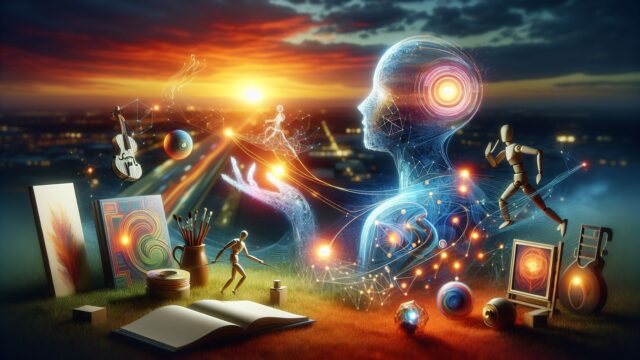
Hey tech enthusiasts! Today, we’re jumping into something that’s been bubbling under the surface but is now taking off in ways I didn’t expect — Artificial Intelligence in creative arts! But not just AI; we’re talking about AI that actually makes art. Imagine Picasso with GPT-4 or Beethoven jamming with machine learning algorithms. Sounds wild, right? Well, it’s not just a daydream anymore—it’s actually happening, and I’m fascinated by it.
The Unlikely Muse: AI Steps into Creative Arts
AI jumping into the arts feels like watching a serious scientist suddenly grab a beret and start flinging paint around a studio. Sounds weird, but it’s opening up completely new ways for people to create. With AI models like OpenAI’s DALL-E and DeepMind’s WaveNet, artists, musicians, and writers have tools that can actually work alongside them and sometimes push their work in directions they never expected.
I remember the first time I saw an AI-generated painting that made me stop dead in my tracks. “Wait, did a human make this or a machine?” I found myself staring at it, feeling this weird mix of amazement and confusion. It was like watching magic, but also kind of unsettling. That moment really hit me — AI was changing what ‘creativity’ even means. It’s not just a human thing anymore; it’s become this space where computer logic meets human gut instincts, and the results are pretty mind-bending.
AI Tools of the Trade: The Palette Grows
Ever heard of Amper Music? If not, you’re in for a treat! Amper is this platform that lets literally anyone create custom music tracks, even if you can barely hum in tune. It uses AI to figure out what kinds of sound patterns humans actually like listening to. Want a soundtrack for a lazy Sunday afternoon? Amper’s got you covered. Need some pumping electronic beats for a workout video? Done. Sometimes it feels like the thing can read my mind, which is honestly a little creepy.
Then there’s DALL-E, which is like having a magic lamp for visual artists. You can type something like “futuristic cityscape under a glowing purple sky” and watch it materialize on your screen. These AI models aren’t just tools sitting there waiting for commands; they feel more like creative partners that sometimes surprise you with ideas you never would have thought of.
A Double-Edged Paintbrush: Challenges of AI in Arts
Of course, nothing this cool comes without a bunch of messy complications. When AI started cranking out art and music, people immediately started worrying: are human artists about to become obsolete? Is creativity turning into some kind of assembly line process instead of something that comes from the soul? And don’t even get me started on the legal nightmare around copyright. Who actually owns something an AI creates? The programmer? The algorithm itself? Your guess is as good as mine.
Just last year, a well-known artist actually sued an AI company for ‘stealing’ their artistic style. It made huge headlines and started this debate that raised way more questions than it answered. I mean, how do you even define art theft when machines can learn someone’s style faster than most people can spell “impressionism”? It’s a mess, but it’s a fascinating mess.
The Collaborative Future: AI and Human Artists
But here’s what I find really interesting — instead of running away scared, a lot of artists are actually embracing AI as a creative partner. It’s like upgrading from a regular paintbrush to one that thinks alongside you. Writer Robin Sloan has been using AI to co-write short stories, and he describes it as “collaborating with a machine on narrative.” That sounds like something straight out of a sci-fi movie, but it’s happening right now.
And fashion? Oh man, fashion is getting completely turned upside down. IBM’s Watson has been working with designers at major brands to create pieces that blend human creativity with machine precision. New patterns, fabrics, and styles are coming out of these partnerships that challenge everything we thought we knew about how fashion gets made. Some of it works brilliantly. Some of it… well, let’s just say AI still has some learning to do about what humans actually want to wear.
Speculating on Tomorrow: AI Artscape Ahead
So where does this all lead? I love thinking about this stuff, so bear with me while I get a little speculative. In ten years, we might have AI creative assistants that give you real-time feedback while you’re painting or writing. Stories could become these interactive experiences where the AI predicts what the audience wants and adapts on the fly. Dance, theater, performance arts — imagine AI choreographers and directors joining the mix. It sounds incredible and terrifying at the same time.
What gets me excited about AI in creative arts is that it’s not really about replacing human creativity; it’s about amplifying it in ways we’re only starting to understand. This isn’t art versus algorithm — it’s art plus algorithm. And honestly? I think that’s pretty amazing.
Wrapping this up, here’s what I keep coming back to: great artists have always worked in harmony with their tools, whether that’s a brush, a pen, or now a line of code. Let’s see where this wild ride takes us! I’m curious what you think — are you excited about our new AI creative partners, or does this whole thing make you nervous? Drop a comment below; I genuinely want to know how you’re feeling about this colorful, connected, and slightly chaotic future we’re heading into!