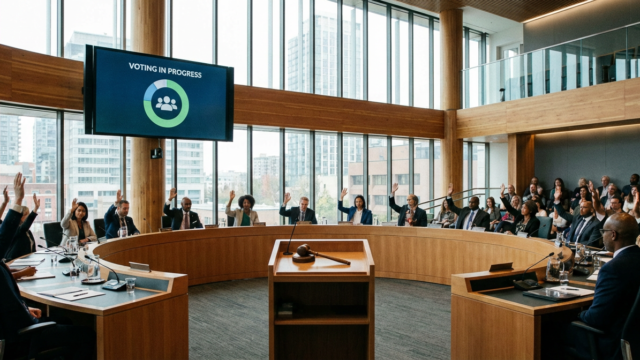
What happens when a grieving mother stands at a podium for three minutes and changes the trajectory of a $2.4 million infrastructure project? I found out Tuesday night, sitting in the back row of Council Chambers with my usual stack of budget documents and a thermos of coffee that had gone cold hours earlier.
Maria Santos wasn’t on my list of expected speakers for the evening’s agenda. The 47-year-old nurse had never addressed the council before, never filed a public records request, never even attended a meeting. But when she stepped up to speak during public comment about the proposed speed bump installation on Maple Street, her voice carried the weight of every parent who has watched their child walk to school on a street that doubles as a shortcut for morning commuters.

The Numbers Behind the Emotion
The Maple Street corridor improvement project had been buried in agenda item 7B for six months. A straightforward traffic calming measure that would install twelve speed bumps between Roosevelt Elementary and the community center. City Engineer David Chen had presented clean data: average speeds of 38 mph in a 25 mph zone, 847 vehicles during school hours, zero accidents in the past three years.
Santos brought different numbers. Her eight-year-old son Diego times his walk to school every morning, she told the council. Four minutes and thirty-seven seconds from their front door to the crosswalk, where he waits for crossing guard Patricia Williams to wave him across. Williams has been requesting additional safety measures for two years through official channels, Santos noted, submitting three separate reports that apparently never made it past the Parks and Recreation department.
Council member Janet Rodriguez immediately pulled out her phone. Within five minutes, she had Williams on speaker, confirming details that should have been part of Chen’s original presentation. The crossing guard’s daily logs, meticulously kept in a composition notebook, showed seventeen near-miss incidents since school started in August.
When Process Meets People
The disconnect revealed Tuesday night shows a persistent challenge in local governance: how thoroughly researched proposals can still miss critical community input. Chen’s traffic study, conducted by professional consultants over a three-month period, included speed monitoring, accident analysis, and pedestrian counts. It did not include conversations with the people who use the street every day.
Mayor Susan Walsh, who typically runs meetings with military precision, paused the proceedings to ask Santos and Williams to join city staff at the table. For twenty minutes, the formal agenda disappeared as the council heard about morning traffic patterns from residents rather than consultants. Williams described how delivery trucks use Maple Street to avoid the construction zone on Third Avenue, creating blind spots near the school entrance. Santos’s neighbor, retired mechanic Frank Torres, explained how the street’s slight downhill grade encourages speeding, especially during afternoon pickup times.
This isn’t the first time resident testimony has reshaped a council decision. Last spring, small business owner Carmen Rodriguez’s three-minute comment about downtown parking meters led to a six-week revenue analysis that ultimately saved the historic district from losing weekend foot traffic. The previous winter, high school student Alex Chen’s presentation on late-night bus service resulted in extending Route 12 hours to accommodate students working evening jobs.
The Real Cost of Community Safety
By 9:30 PM, what started as a routine infrastructure approval had turned into something more complex. Council member James Morrison pulled up the city’s Vision Zero commitment, adopted unanimously in 2019, which pledges to eliminate traffic deaths and serious injuries by 2030. The Maple Street project’s $47,000 budget suddenly looked inadequate when measured against this broader safety framework.
Finance Director Linda Park ran new numbers in real time, calculating the cost of adding crosswalk improvements, enhanced signage, and a flashing beacon system that Williams had researched on her own time. The enhanced package would total $89,000, requiring council to reallocate funds from the general capital improvement reserve.
Rodriguez made the motion to approve the expanded scope, seconded immediately by Morrison. The vote was unanimous, but more importantly, it established a new protocol. Future traffic safety projects will now include mandatory community input sessions before final design, with particular attention to feedback from school personnel, crossing guards, and neighborhood watch coordinators.
Beyond Tuesday’s Vote
The Maple Street decision reflects broader changes in how our city council approaches community engagement. Walsh announced plans for quarterly neighborhood forums, rotating through different areas of the city to gather input before issues reach the formal agenda stage. Public Works Director Michael Torres will begin attending elementary school pickup times to observe traffic patterns firsthand, supplementing data collection with direct observation.
These changes matter because they address a fundamental question about representative democracy: how do elected officials balance professional expertise with community knowledge? Santos’s three minutes demonstrated that residents possess critical information that surveys and studies often miss. Williams’s crossing guard logs provided more useful insights than months of traffic counting equipment.
The enhanced Maple Street improvements will begin construction in January, with completion scheduled before the spring semester. Santos will join the city’s new Community Safety Advisory Committee, along with Williams and two other crossing guards from different schools. Their first assignment: reviewing traffic patterns around all elementary and middle schools to identify similar safety gaps before they require emergency intervention.
Tuesday’s meeting ran until 10:15 PM, longer than usual, but it ended with something rarely seen in municipal government: applause from the gallery. Not for the council’s decision, but for the process that led to it. When community members feel heard rather than processed, when their expertise is valued alongside professional analysis, local government works the way it was designed to work. Every neighborhood deserves advocates who understand that the best data often comes from the people who live the reality those numbers represent.